NEWSLETTER 132 / MARCH 2026
1 – ANNUAL GENERAL MEETING
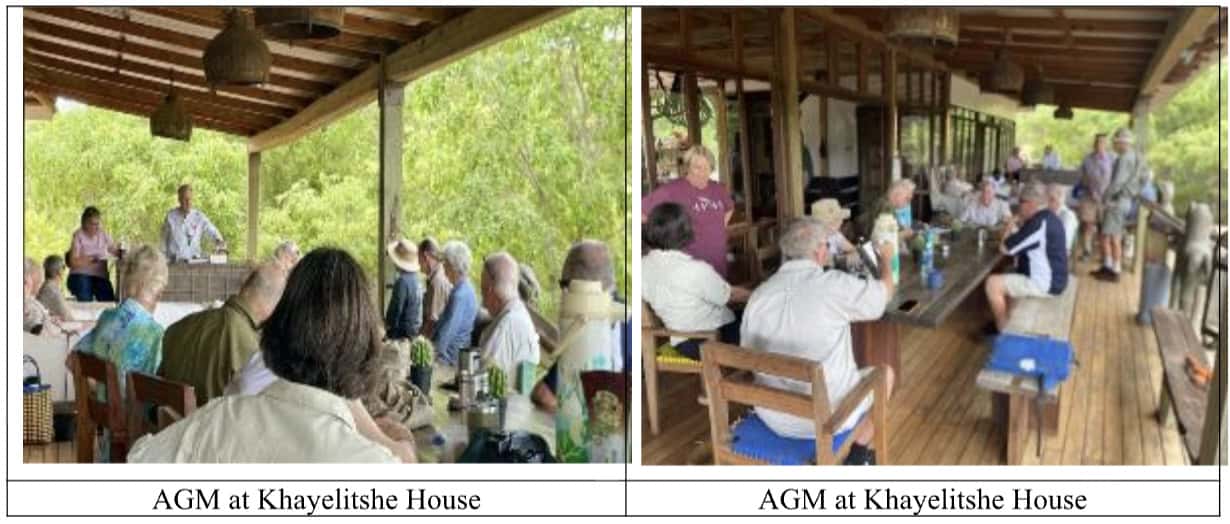
The Annual General Meeting was held at Khayelitshe House on Sunday 23 rd November. We
appreciate the good turnout and debate that followed.
Subsequent to the AGM, Nicola Watson agreed to take up the post of treasurer and was co-opted onto
the committee. Consequently, your committee comprises:
Chairman Gavin Stephens
Vice-Chairman Neil Rix
Treasurer Nicola Watson
Secretary Gaynor Lightfoot
Membership Jean Whiley
Committee Members Verity Bowman, Dennis Chitewe and John Dold
At the AGM Moira Fitzpatrick stood down from the committee. Moira has been an invaluable
resource, providing a direct link to NMMZ and much important input. Whilst we will miss her direct
input, she will remain a valued member and a point of ongoing reference.
We again thank Becks Ndlovu and the Khayelitshe team for hosting us.
2 – PVO
As resolved at the AGM, the Constitution of the MCS will be amended to comply with the Private
Voluntary Organisations Act, and the Society will endeavour to be registered. It’s a bewildering
process with many contradictory moves, and a Constitutional Court challenge on the table.
Despite our misgivings of the whole process, we must comply and are proceeding accordingly.
3 – RAINFALL
We have had an excellent rainy season, with all stations above annual average and no end in sight.
Surprisingly, Matabeleland has been much wetter than Mashonaland! Year to date rainfall (7 Mar
2026):
Western Matopos 652mm, Central Matopos 743mm, Eastern Matopos 1,013mm and Bulawayo
682mm
2
4 – NEXT EVENT
Date Sunday 22 March 2026
Venue Mtshashasha Falls
Meet 08:15 for 08:30 departure, Cresta Churchill
Travel High ride vehicles preferred
We will travel out to Mshashasha Falls (Cascades) via the Matopos, Fort Usher and Old Gwanda
roads. These roads have just been graded and so currently are not too bad, but this is subject to rain in
the next few weeks! These falls are the highest in the Matopos, and for the bold, bring your swimming
costume. There is a minimum 45 min walk (3km), downhill on the way there, uphill on the way back!
We suggest you carry water and some food. The walk through the forest is spectacular, whilst the falls
are impressive. The Eastern Matopos has received over 1,000mm so the river should be flowing well.
We plan to return to the vehicles for a late picnic lunch.
Vehicles will leave in convoy from Cresta Churchill and regroup at Matopo Mission.
Please note that climbing in the area of the falls is dangerous and fatalities have occurred. Members
proceed at their own risk.
5 – REPORT BACK – KHAYELITSHE
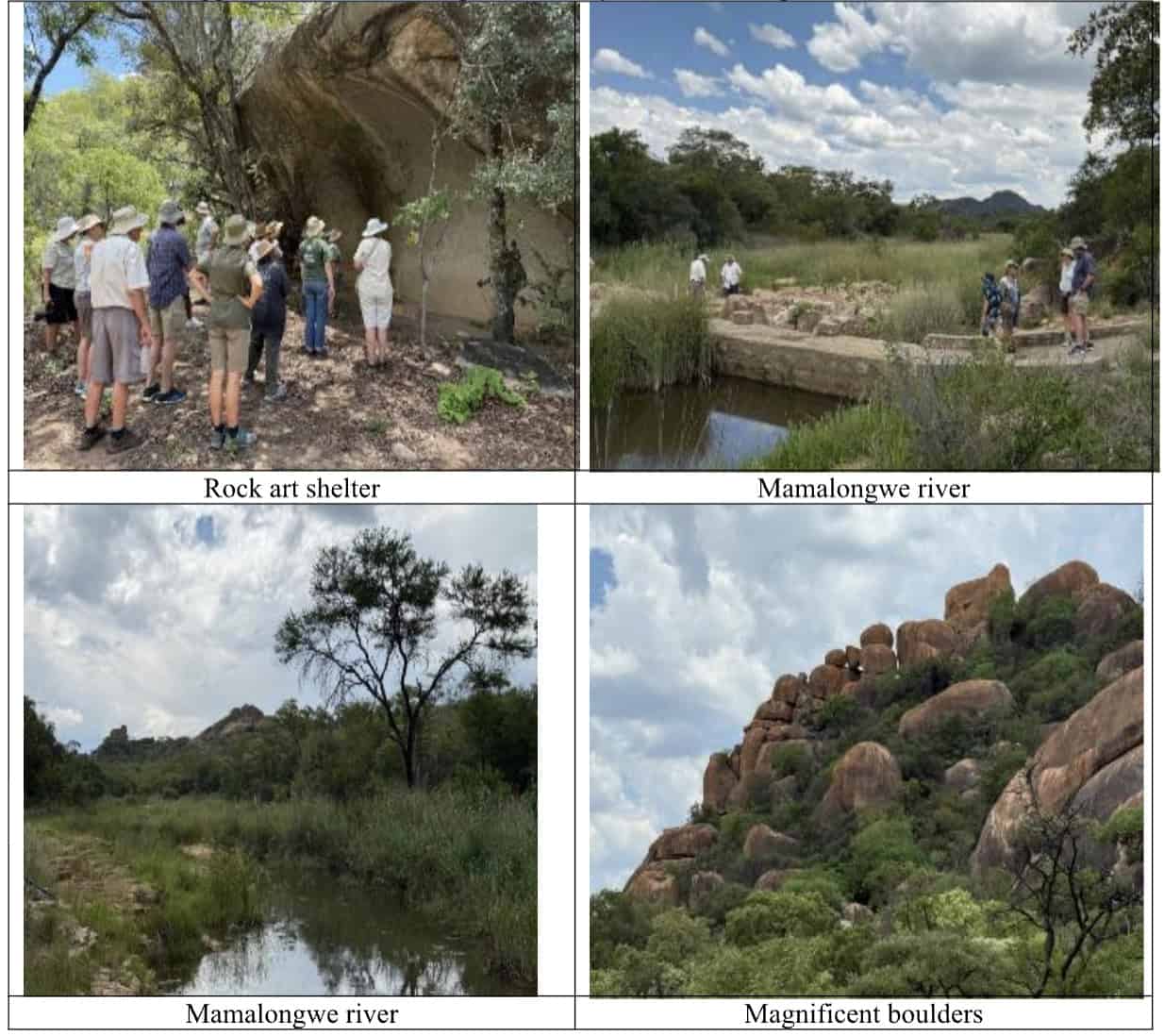
The AGM in November incorporated a field trip to the Khayelitshe property. The Khayelitshe guides
took our members for a walk on the property after the AGM and tea had been concluded. Initially we
visited a rock art site close by, which was of interest, and then proceeded on a walk down to the
Mamalongwe River, arriving at a causeway above the junction with the Maleme river. Following
early rain, trees were already green and there was water in the river from the previous season. Whilst
discussing vegetation and butterflies, we noticed a growing thunderstorm, and so it became a race
back to the House to avoid a drenching. Not that anyone complained!
The shower passed and a picnic lunch was then held before members started to meander off in the
afternoon. We appreciate the attention given to us by the staff throughout our visit.
6 – RHODES MATOPOS NATIONAL PARK CENTENARY
Our beloved Matopos National Park officially turns 100 years old in November this year. To this end
National Parks are planning a number of celebratory events from 19 th to 21 st November to mark the
founding of the country’s oldest National Park, and your Society will be involved. More details will
be shared with you in due course.
Whilst the Park has it origin in Rhodes 1902 will that bequeathed the Hazelside and World’s View
Farms to the “People of Bulawayo” it was not until 1926 that a Park was formally promulgated. The
original Park was much larger than the current park, but we’ll cover that in a future article.
7 – GREAT ZIMBABWE MONUMENT DEVELOPMENT PROJECT NEARS
COMPLETION
Sunday Mail, November 9, 2025
The €3 million Great Zimbabwe World Heritage Site development project is edging towards
completion, with construction of a new visitors’ centre expected to be finalised before year-end,
marking the culmination of a transformative initiative set to redefine the historic tourist attraction.
President Mnangagwa launched the three-year Great Zimbabwe Monument Development Project in
June 2022. Funded by the French Development Agency and partners, the project aims to preserve and
safeguard the heritage site for future generations. The initiative is being implemented by the United
Nations Office for Project Services (UNOPS) in collaboration with the National Museums and
Monuments of Zimbabwe (NMMZ). There is also additional support from the United Nations
Educational, Scientific and Cultural Organisation. Upon completion, the upgraded site is expected to
attract more visitors through enhanced facilities that meet international standards. This aligns with the
Second Republic’s drive to boost tourism as a key pillar of economic growth
8 – ZIMBABWE SECURES KEY UNESCO SEAT
Zimbabwe clinched a significant diplomatic victory on Wednesday, earning a seat on the UNESCO
Executive Board after a commanding performance in the global vote.
The election, held during the 43 rd UNESCO General Conference in Samarkand, Uzbekistan, positions
Zimbabwe to help shape international policy on education, science, culture, and heritage preservation
for the next four years.
In a related push at the conference, Zimbabwean officials advocated for the unconditional repatriation
of cultural artefacts and human remains taken during the colonial era.
“Our major thrust is ensuring that the remains of our forefathers and artefacts, such as the Zimbabwe
Bird, are returned without conditions,” said Nicholas Moyo, Permanent Secretary for the Ministry of
Sport, Recreation, Arts and Culture.
“These objects are part of our identity and spirit. Their return will allow the souls of our ancestors to
rest in peace.”
He added that the country also aims to have more of its heritage listed on UNESCO’s World
Registers.
ED: For the record, the missing Zimbabwe Bird is at Groote Schuur, Cape Town, South Africa so the
question is why has South Africa not returned it?
9 – FOREIGN TOURISTS TO PAY EXTRA FEE TO VISIT USA NATIONAL
PARKS
With acknowledgement to the BBC, Wednesday November 26, 2025
Foreign tourists visiting popular US national parks like the Grand Canyon and Yosemite will need to
pay an extra fee, the Trump administration said on Tuesday.
The Department of the Interior, which runs the country's national parks, said each international visitor
will need to pay $100 (£76) on top of existing fees to access 11 of the most popular sites.
From 2026, non-residents will also need to pay more than $250 for an annual pass to the parks, while
US citizens and permanent residents will continue to pay $80.
The fee hike aims to "put American families first" and reflects President Donald Trump's goal to make
the parks more accessible and affordable for US citizens, said the department.
"These policies ensure that U.S. taxpayers, who already support the National Park System, continue to
enjoy affordable access, while international visitors contribute their fair share to maintaining and
improving our parks for future generations," said Secretary of the Interior Doug Burgum.
The increase will take effect at the start of 2026, alongside the launch of an upgraded online booking
system and better access for motorcyclists across the parks.
4
In its announcement, the department also noted eight resident-only, "patriotic fee-free" days for 2026,
including Memorial Day, Independence Day and Veteran's Day.
The fee hike follows an executive order, signed by Trump in July, to raise entrance fees at national
parks for overseas visitors. The extra revenue would raise funds for conservation and maintenance at
the sites, the White House said at the time – even as the Trump administration planned deep cuts to the
Park Service budget.
US national parks have seen record numbers of tourists in recent years, with upwards of 331 million
visitors in 2024 – an increase of at least 6 million compared to the year before.
The country's most visited parks include the Everglades in Florida, Yosemite in California and
Colorado's Rocky Mountains.
10 – NUCLEAR-TAGGED RHINO HORNS: S.A’S ANTI-POACHING BET
With acknowledgement to ESI Africa, 4 August 2025
After two years of initial tests, the Rhisotope Project was created in 2021 with the idea to tag rhino
horns with radioactive material. This follows a successful pilot aimed at combatting wildlife
trafficking of rhinoceros, a university in South Africa has officially begun the safe insertion of
radioactive isotopes into the endangered animals’ horns.
The project is leaning on available nuclear technology security infrastructure to deter and detect
illegal poaching.
It is being implemented with the support of the International Atomic Energy Agency (IAEA).
ESI Africa spoke to Sengiphile Simelane, Group Executive: Power and Energy at the South
African Nuclear Energy Corporation (NECSA) about the role of nuclear in the SA mix
With more than 10,000 rhinos lost to poaching in the past decade, South Africa – home to the world’s
largest population of rhinos – remains a target for criminals driven by the illegal trade of rhino
horn. In the first quarter of 2025 alone, the South African Ministry of Forestry, Fisheries and the
Environment reported 103 rhinos poached.
In response, this project run by the University of the Witwatersrand is using radiation to support
conservation and enforcement efforts.
Nuclear technology and rhinos
After two years of initial tests, the Rhisotope Project was created in 2021 with the idea to tag rhino
horns with radioactive material.
This makes the horns detectable by radiation portal monitors (RPMs) already deployed at borders,
ports and airports worldwide. These RPMs, commonly used to detect nuclear and other radioactive
material, can now be harnessed against wildlife crime.
The IAEA’s support to the Rhisotope Project leverages its central role in strengthening the global
nuclear security framework.
With millions of vehicles and people crossing borders every day, the use of an estimated 10,000
RPMs worldwide has become a critical tool for detecting unauthorised transboundary movements of
nuclear and other radioactive material, said the IAEA.
“The Rhisotope Project shows how nuclear science and nuclear technology security infrastructure can
be used in new ways to address global challenges.
“The IAEA is supporting countries to maximise the benefits of nuclear. By using already installed
nuclear security infrastructure in novel ways, we can help protect one of the world’s most iconic and
endangered species,” said IAEA Director General Rafael Mariano Grossi.
Test results pave way for safe use of nuclear on rhino horns
At an event last week in the Waterberg, Limpopo, about 250 kilometres north of Johannesburg, the
University of Witwatersrand announced the results of the rigorous safety assessments conducted
during the pilot phase of the project.
In June last year, radioisotopes were inserted into 20 rhinos. Health monitoring and cytological
examinations of 15 treated animals and a comparison of five animals not treated were conducted by
Ghent University in Belgium.
The test results proved that the method is non-invasive and does not pose a risk to the rhinos’ health.
“This has been an international collaboration of likeminded individuals who are trying to make a real
difference to this poaching crisis.
“We started with the question: ‘what if radiation could protect rather than harm, by turning rhino
horns into traceable markers that stop poachers before they trade?’ After two years of digital
modelling, safety testing and detection simulations, we’re ready to roll out a solution that could truly
reduce rhino poaching,” said James Larkin, Director, Radiation and Health Physics Unit at the
University of the Witwatersrand.
5
The success of project also opens the door for future applications to other endangered species.
“The methodology could be adapted to protect other endangered species like elephants or pangolins,”
said Larkin.
IAEA support for rhino-nuclear project
The IAEA is providing both technical and financial support to the project under its Coordinated
Research Project titled Facilitation of Safe and Secure Trade Using Nuclear Detection Technology –
Detection of RN and Other Contraband
As part of the project, the Agency also supports countries in their efforts to optimise the detection of
radiation by the use of its Minimum Detectable Quantity and Alarm Threshold Estimation Tool,
thereby allowing detection of the tagged with radiation rhino horns.
“The Rhisotope Project brings the entire global nuclear security network into play.
“The nuclear security infrastructure that exists in many countries around the world to detect
smuggling of nuclear and other radioactive material can be used to pick up the trafficking of rhino
horn, and any other contraband that might be carried alongside it. Committing to nuclear security pays
off in multiple ways,” said Elena Buglova, Director of the IAEA Division of Nuclear Security.
11 – FIX THE CAUSE, NOT JUST THE CRISES: A CALL TO RETHINK
CONSERVATION
Michelle Govender describes herself as “a conservationist at heart wearing a marketer’s cap”. It’s a
mix that makes sense when you see where she’s chosen to make her mark: connecting everyday South
Africans to the urgent work of WWF South Africa, and reframing conservation as a frontline solution
to some of the country’s biggest social challenges.
As Head of Individual Fundraising at WWF South Africa, working closely with non-institutional
donors, she doesn’t mince her words about the stakes: “We’re spending billions treating symptoms
while investing only millions in the cure. Amid a growing humanitarian crisis, conservation can seem
like a distant concern, but it’s environmental degradation that fuels many emergencies. Every drought
that displaces communities and every flood that destroys homes is a direct result of how we are
treating our planet.
“It’s a false choice to think we can save people now and fix the environment later,” continues
Govender. “Here in South Africa, when wetlands are destroyed, floods get worse. When catchments
degrade, a water crisis follows. Nature and people are not separate; they thrive together, or they fail
together.”
Govender’s own journey didn’t start in conservation. Before joining WWF, she spent years in
corporate marketing, selling products that often ended up in landfills. “I wanted to be part of
something bigger than myself, something that mattered, something my children could be proud of. My
role now is more dynamic, more collaborative, and more fulfilling.”
At WWF South Africa, she found a place where bold ideas meet real impact and where fundraising is
about building a movement. “I used to think conservation was about saving wildlife. Now I see it’s
about saving systems – our water, food security, jobs, and health.”
Conservation is about people, too
A pivotal moment for Govender came last year during a donor visit to Hoedspruit to witness a rhino
dehorning; a necessary tactic to protect the species. “What stuck with me was how supporters realised
that poaching is tied to poverty, unemployment and communities disconnected from their natural
resources. Conservation is about people, too.”
She believes South Africa’s next generation of donors is already seeing this. “Young people here
don’t separate climate justice from social justice. They want transparency, they want to know their
money makes a real difference.”
Govender’s vision for WWF South Africa’s 2030 strategy is to grow a local donor base that sees itself
as part of a national solution. “When people realise their choices, from what they eat to how they
shop, are connected to the big picture, giving becomes personal, not transactional.”
It’s not easy work. Fundraising in South Africa means tackling fatigue and economic pressure head-
on. “It’s equal parts heart and hustle. You have to tell stories that stir emotion but back them up with
solid results.”
Still, Govender says it’s the small wins and the hope they carry that keep her going. “When you see
protected areas expand, when the Cape mountain zebra’s numbers go up, you know it’s possible to fix
the cause, not just fund the crisis.”
About WWF
The World Wide Fund for Nature, WWF, is one of the world’s largest and most respected
independent environmental organisations, with a global network active in more than 100 countries,
6
including South Africa. WWF’s mission is to stop the degradation of the natural environment and to
build a future in which humans live in harmony with nature, by conserving our biological diversity,
ensuring that the use of renewable natural resources is sustainable, and promoting the reduction of
pollution and wasteful consumption.
12 – ZIM TARGETS 250 000 HECTARE WETLAND RECLAMATION
With acknowledgment to The Herald, Wednesday February 4, 2026
Zimbabwe will continue providing diplomatic leadership to the world in the management, protection
and restoration of wetlands, drawing from its rich traditional knowledge systems and modern
interventions, Government has said. Through multi-stakeholder participation anchored on traditional
leadership and the community, Zimbabwe has reaffirmed its commitment to reclaim 250 000 hectares
of degraded wetlands by 2030. This is part of broader targets the country set after assuming the
presidency of the Conference of the Contracting Parties to the Convention on Wetlands (Ramsar
COP15) in Victoria Falls last year. Zimbabwe seeks to designate 5 new RAMSAR sites to add to the
current 7 sites. Wetlands face increasing pressure from human habitation and activity, with 64% of the
world’s wetlands having disappeared.
13 – SOCIETY CALENDAR OF EVENTS FOR YOUR DIARY
22 March 2026 MCS Field Trip
25 – 29 March 2026 Matopos Heritage MTB Challenge
11 April 2026 Matopos 33 Miler
05 June 2026 World Environment Day
21 – 23 August 2026 Matopos Heritage Trail Run
19 – 21 November 2026 Rhodes Matopos National Park Centenary Celebrations
22 November 2026 MCS 34 th Annual General Meeting (date TBC)
28 – 30 November 2026 Matobo Classic
14 – MEMBERS NOTEBOOK
Subscriptions
Subscriptions for the year 1 October 2025 to 30 September 2026 are now due. Please ensure that your
subs are up to date. There has been no increase in rates.
US$ 20 Individual/Family
US$ 5 Pensioner/Student
US$100 Corporate
If you need any information, please contact matoboconservatiosociety@gmail.com
MCS Branded Apparel
The Society has a small stock of sleeveless fleece jackets, in olive green with orange MCS logo,
available at US$20 each. They are ideal for the cool mornings and evenings. We also have stocks of
hats and caps at $10 each. CD’s and shopping bags are also available at $5 each. Please contact the
Secretary via WhatsApp +263 71 240 2341 for further details
Website – www.matobo.org
Visit our website and make use of the RESOURCES tab for downloading maps and information.
Please email to matoboconservationsociety@gmail.com
Facebook
Don’t forget to join our Facebook page, with nearly 1000 members now.
The Natural History of the Matobo Hills
This MCS publication is available at the Natural History Museum for US$30.
Umvukela – The 1896 Anti-Colonial Rebellion in Matabeleland by IJ Cross
This limited edition book has just been published by the Matobo Conservation Society as it records an
important part of the Matopos History. Available at $50 each – as stocks last. Contact the Secretary.
15 – IN MEMORIUM
Since our last Newsletter we have been saddened by a number of unexpected deaths.
JOAN STEPHENS
7
The MCS is saddened by the loss of our oldest and Honorary Member, Joan Stephens who passed
away unexpectedly on 19 December 2025. She rarely missed a field trip, no matter the weather, and
was an avid supporter of the Society from its inception. Joan was always there to assist and will be
remembered at the annual Matopos Heritage MTB Challenge where she volunteered for all previous
16 events. She was a knowledgeable amateur botanist, a keen birder and a lover of wildlife. In her
many years she will have walked and hiked many parts of our special hills rarely seen by others. Joan
was also the matriarch at Camp Dwala – a special part of the Hills where her ashes were laid to rest.
Small in stature but big in heart.
JOHN BREBNER
John Brebner passed away on Friday 6th February, after a short but intensely painful battle with
cancer.
He is now flying free with his Black eagles in Matopos, the place where he always felt most at home.
His contribution to the Black Eagle Survey was immense but we have been assured that his work will
go on. He also served Friends of Hwange and WEZ.
John lived his life diligently, loyally, and quietly, without fuss. Whether it was with family, friends,
work, wildlife, or his beloved eagles, he approached everything with the same steady devotion and
humility. Fly high John.
MARTIN SANDERSON
Martin Sanderson, a dedicated educator, a historian, a master story teller, a colleague and a man who
had a wealth of knowledge, passed away on Friday 20 th February. He was a gentleman and a friend to
all.
Many past pupils have his activities, whether at the top of Ntabazinduna, in his beloved Matopos or in
the Natural History Museum, firmly imprinted in their memories. He had a unique method of
instilling life-long experiences. He leaves behind a legacy of learning through the Resource Centre at
Whitestone School, where the inspirational sessions of ‘Adventure into Learning’ take place.
We extend our deepest condolences to the family and friends of our departed members. They will be
missed on our regular outings.